Overview of Change Management
This content is currently under development.
The Project Change Management Process is followed during the Execution phase of the Project Management Life Cycle, once the project has been formally defined and planned.
What is a Change Management Process
A Change Management Process is a method by which changes to the project (e.g. to the scope, deliverables, timescales or resources) are formally defined, evaluated and approved prior to implementation. The process entails completing a variety of control procedures to ensure that, if implemented, the change will cause minimal impact to the objectives of the project.
A Change Management Process is used to ensure that every change identified is formally:
When to use a Change Management Process?
Any change to the project during the Execution phase will need to be formally managed as part of the Change Management Process. Without a formal Change Management Process in place, the objective of delivering a solution within ‘time, cost and quality’ may be compromised.
The Change Management Process is terminated only when the Execution phase of the project is completed (i.e. just prior to Project Closure).
Change Management Process
Overview
The Change Management Process is undertaken to ensure that each change introduced to the project environment is appropriately defined, evaluated and approved prior to implementation.
Change Management will be introduced to this project through the implementation of five key processes:
The following diagram describes the roles, processes and procedures to be undertaken to initiate, implement and review the effects of changes within the project.
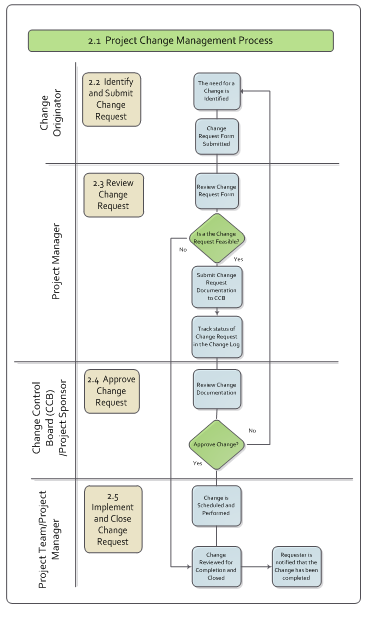
Identify and Submit Change Request
This process provides the ability for any member of the project team to submit a request for a change to the project.
The Change Requester:
The RFC summarizes the change:
Review Change Request
The Project Manager reviews the RFC and determines whether or not additional information is required for the Change Advisory Board to assess the full impact of the change to the project time, scope and cost.
The decision will be based on factors, such as:
The Project Manager will record the RFC details in the Change Log to track the status of the change request.
Approve Change Request
The Project Manager will forward the Change Request Form and any supporting documentation to the Change Advisory Board or Emergency Change Advisory Board (ECAB) for review and final approval.
They will determine the feasibility of this change by examining factors, such as:
After a formal review, they may:
Implement and Close Change Request
If the change is approved, the following will occur:
Change Management Roles
The following will play a role in the request, review, tracking and approval of a change request:
Change Requester
The Change Requester initially recognizes a need for change to the project and formally communicates this requirement to the Project Manager. The Change Requester is responsible for:
Project Manager
The Project Manager receives, logs, monitors and controls the progress of all changes within a project. The Project Manager is responsible for:
Change Control Board
The Change Advisory Board (CAB) is the Steering Committee or other authorized body who is the principle authority for all RFCs forwarded by the Project Manager. The Change Advisory Board Group is responsible for:
Project Team/Project Manager
The Project Team and Project Manager schedules and implements all changes. This group is responsible for:
Change Management Documents
The following documentation is used to monitor and/or control changes to the project.