AWS Import
Adding a schedule
-
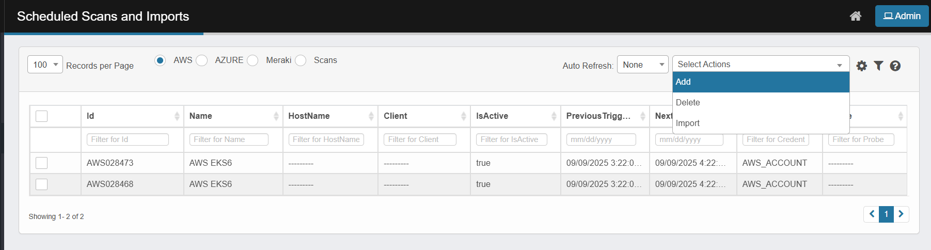
Click AWS at the top, then Select Actions → Add.
-
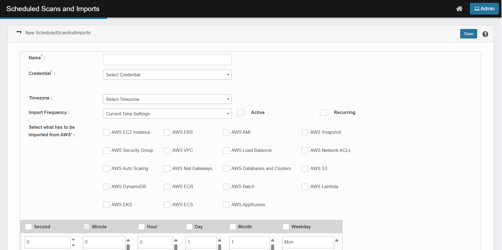
Fill the following details:
-
Name*: e.g., “AWS EKS6 Nightly”
-
Credential*: pick your AWS_ACCOUNT.
-
Timezone: choose the right region.
-
Import Frequency: “Current Time Settings” (then use the pickers below), or leave as default and set the wheels.
-
Toggle Active (must be on to trigger a scan) and optionally Recurring.
-
-
Select what has to be imported from AWS* (at least one):
EC2 Instance, EBS, AMI, Snapshot, Security Group, VPC, Load Balancer, Network ACLs, Auto Scaling, NAT Gateways, Databases and Clusters, S3, DynamoDB, ECR, EKS, Lambda, Batch, AppRunner, etc.Tip: Only tick what you need; fewer services = faster imports.
-
Schedule in the time wheels (Second / Minute / Hour / Day / Month / Weekday).
-
Click Save.
-
The job appears in the AWS list
-
If IsActive=true , NextTriggerTime is calculated and displayed
Importing a AWS Schedule
-
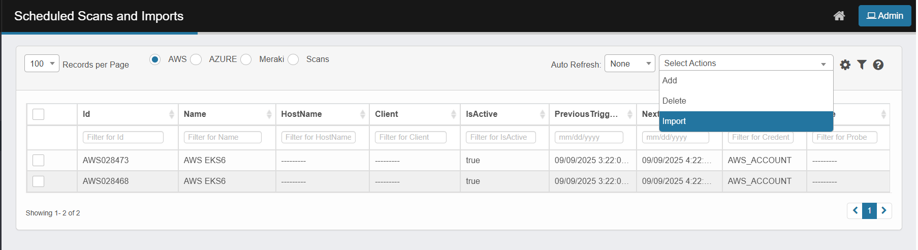
Select the desired rows, open Select Actions, and click Import.
-
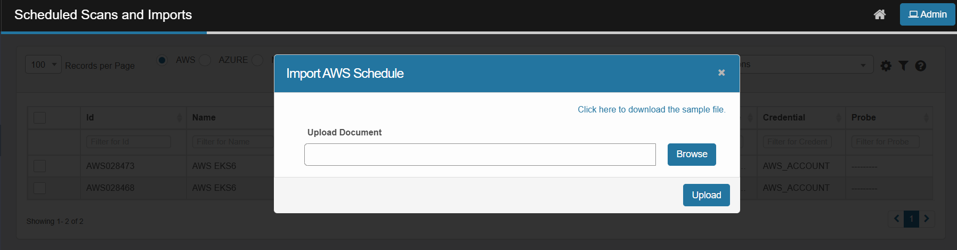
You’ll see the Import <Provider> Schedule popup with a Browse button and a link to Click here to download the sample file.
-
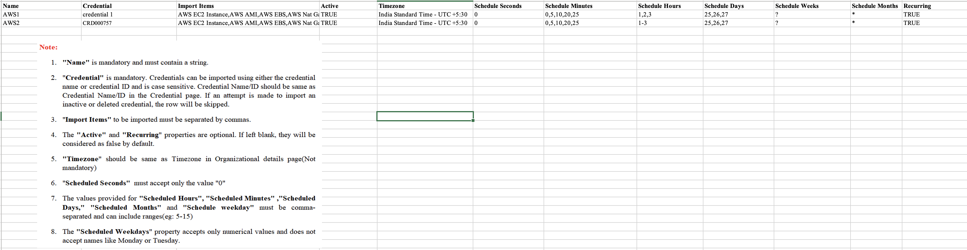
(Optional) Download the template. The format of the template file is as below
Prepare Your File
-
Download template: In the Import AWS Schedule popup, click the link to download the sample file.
-
Headers: Keep the headers exactly as shown in the sample file.
-
Fill in mandatory fields:
-
Name Must contain a string.
-
Credentials Enter Credential Name or Credential ID of AWS Account
-
Imported Items to be imported, must be separated by commas
-
Timezone
-
Schedule fields: second, minute, hour, day, month, weekday
-
-
Fill in optional/additional fields as required:
-
Active: true/false
-
Recurring: true/false
-
Import the File
-
Click Select Actions → Import.
-
In the popup:
-
Click Browse.
-
Select your prepared file.
-
Click Upload.
-
-
Close the dialog.
Verify Imported Schedule
-
The scheduled jobs will appear in the list/grid.
-
If IsActive = true, the system will automatically calculate and display NextTriggerTime.
-
All other relevant columns (including credentials) will be populated.
Deleting a AWS Schedule
-
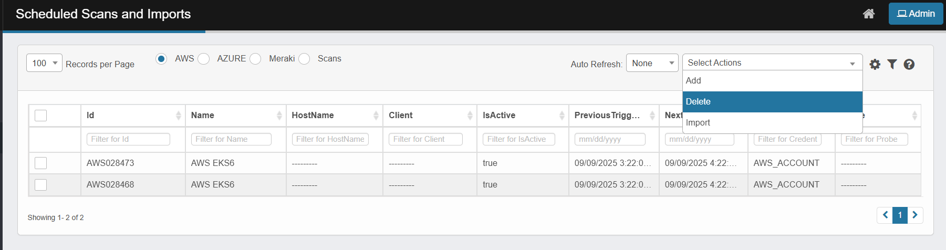
Select the checkbox in the leftmost column for each schedule you want to remove.
-
From the Select Actions dropdown, click Delete.
-
A Delete Confirmation modal appears.
-
In the confirmation box, type Delete (exactly as shown), then click Delete.
The selected schedule(s) are removed and disappear from the grid. -
No imports will be executed from the point of delete
-
If an active import is currently running, The import will be completed